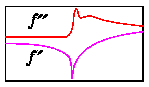
Anomalous Scattering Coefficients
Forms interface to plot theoretical values of f' and f"
It is quite easy to plot the values of f' and f" for the element or elements
you are interested in over any range of energies from 1000 eV (13 Å) to
25000 eV (0.50 Å).
Use the form below to describe the plot you would like to
see. By default the plot will span a fairly large energy range; you will
probably want to reset this to a much narrower region around the edge of
interest.
Notes
When you submit a request the information is fed to
gnuplot
for plotting. If you have gnuplot installed locally
then you have the option to select the
"Send plot as: gnuplot script" button above so that you can
further customize the plot.
Where this data came from:
The scattering factor data files used to generate plots were calculated
using the subroutine library by Brennan and Cowan (see
references).
The values for f' and f" are derived using the theoretical approximation
developed by Cromer and Liberman.
This theory gives accurate values far from an absorption edge but does not
account for the effects of neighboring atoms, which can be very substantial
near an absorption edge.
Before conducting an anomalous scattering experiment close to an
absorption edge it is therefore advisable to determine the actual scattering
behaviour of your sample (see theory v.
experiment).
 X-ray Anomalous Scattering
Ethan A Merritt ©1996-2011/ merritt@u.washington.edu /
University of Washington Deptartment of Biochemistry