 =
(NA/2NT)1/2(2A/Zeff)
=
(NA/2NT)1/2(2A/Zeff)
perturbation in |F| due to
 =
(NA/2NT)1/2(|Aλi - Aλj|)/Zeff
=
(NA/2NT)1/2(|Aλi - Aλj|)/Zeff
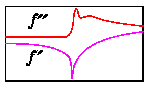
The signal expected from a MAD experiment can be calculated using an approximation analogous to that derived by Crick & Magdoff(1956) for an MIR experiment. The equations used are:
|
perturbation in |F| due to =
(NA/2NT)1/2(2A/Zeff)
perturbation in |F| due to =
(NA/2NT)1/2(|Aλi - Aλj|)/Zeff
|
where
Since the perturbations due to
and are orthogonal, we may take
the net expected signal to be the square root of the sum of their squares.
A remarkable property of anomalous scattering is that it does not fall off with sin(θ)/λ. This means that the contribution of anomalous scattering to the total measured intensity actually increases at higher resolution. On the other hand, your data quality normally falls off at higher resolution, so you may or may not be able to take advantage of this behaviour.
To show how this works, here is an interactive form to calculate the approximate signal expected from a MAD experiment. For more detailed discussion of the signal available from a MAD experiment, see Hendrickson & Ogata (1997) , Bella & Rossmann (1997) , Olczak et al (2003)
 back to index
 next topic